| .. | ||
| esp_tts_chinese | ||
| img | ||
| samples | ||
| CMakeLists.txt | ||
| component.mk | ||
| README_en.md | ||
| README.md | ||

ESP Chinese TTS [中文]
Espressif Chinese TTS is a lightweight TTS system designed for embedded systems。
Overview
The Chinese TTS is based on concatenative method. The flow diagram of system is as follows:
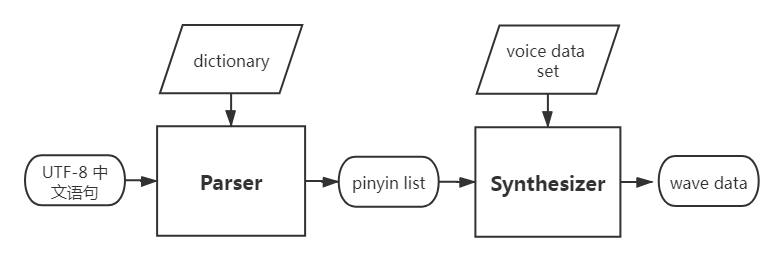
- Parser : a Chinese grapheme to phoneme module, input text (UTF-8) and output Chinese pinyin list.
- Synthesizer : a concatenative synthesizer, input pinyin list and output wave raw data. The default encoding of raw data is mono, 16 bit@16000 Hz.
Features
-
UTF-8 encoding text input
-
Streaming output
-
Polyphonic pronunciation
-
Adjustable speech rate
-
Digital broadcasting optimization
-
Custom sound set
Performance Test
Resource Occupancy
Flash image size: 2.2 MB
RAM runtime: 20 KB
CPU loading test(ESP32 @ 240 MHz):
| speech rate | 0 | 1 | 2 | 3 | 4 | 5 |
|---|---|---|---|---|---|---|
| times faster than real time | 4.5 | 3.2 | 2.9 | 2.5 | 2.2 | 1.8 |
Note: the bigger rate, the faster speech speed. 0: slowest speaking speed, 5: fastest speaking speed.
Samples
-
欢迎使用乐鑫语音合成, voice=小乐,speed=0, voice=小乐,speed=2
-
支付宝收款 1111.11 元, voice=小乐,speed=0, voice=小乐,speed=2
-
空调制热模式已打开,并调节到25度, voice=小乐,speed=0, voice=小乐,speed=4
User Guide
#include "esp_tts.h"
#include "esp_tts_voice_female.h"
#include "esp_partition.h"

/*** 1. create esp tts handle  ***/

//// Method1: use pre-define xiaole voice lib.
//// This method is not recommended because the method may make app bin exceed the limit of esp32
// esp_tts_handle_t *tts_handle=esp_tts_create(esp_tts_voice_female);


// method2: initial voice set from separate voice data partition

const esp_partition_t* part=esp_partition_find_first(ESP_PARTITION_TYPE_DATA, ESP_PARTITION_SUBTYPE_DATA_FAT, "voice_data");
if (part==0) printf("Couldn't find voice data partition!\n");
spi_flash_mmap_handle_t mmap;
uint16_t* voicedata;
esp_err_t err=esp_partition_mmap(part, 0, 3*1024*1024, SPI_FLASH_MMAP_DATA, (const void**)&voicedata, &mmap);
esp_tts_voice_t *voice=esp_tts_voice_set_init(&esp_tts_voice_template, voicedata);

// 2. parse text and synthesis wave data
char *text="欢迎使用乐鑫语音合成";
if (esp_tts_parse_chinese(tts_handle, text)) {  // parse text into pinyin list
	int len[1]={0};
	do {
		short *data=esp_tts_stream_play(tts_handle, len, 4); // streaming synthesis
		i2s_audio_play(data, len[0]*2, portMAX_DELAY);  // i2s output
	} while(len[0]>0);
	i2s_zero_dma_buffer(0);
}
please refer to esp_tts.h for the details of API or chinese_tts example in esp-skainet.