| .. | ||
| README_CN.md | ||
| README.md | ||

Model loading method[中文]
In esp-sr, both WakeNet and MultiNet will use a large amount of model data, and the model data is located in ESP-SR_PATH/model/.
Currently esp-sr supports the following model loading methods:
ESP32:
- Load directly from Flash
ESP32S3:
- Load from Flash spiffs partition
- Load from external SDCard
So that on ESP32S3 you can:
- Greatly reduce the size of the user application APP BIN
- Supports the selection of up to two wake words
- Support online switching of Chinese and English Speech Command Recognition
- Convenient for users to perform OTA
- Supports reading and changing models from SD card, which is more convenient and can reduce the size of module Flash used in the project
- When the user is developing the code, when the modification does not involve the model, it can avoid flashing the model data every time, greatly reducing the flashing time and improving the development efficiency
1. Model configuration introduction
Run idf.py menuconfig navigate to ESP Speech Recognition:
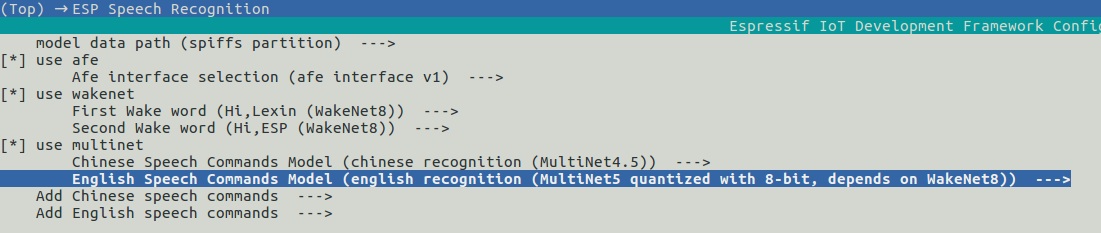
1.1 model data path
This option is only available on ESP32S3. It indicates the storage location of the model data. It supports the choice of spiffs partition or SD Card.
spiffs partitionmeans that the model data is stored in the Flash spiffs partition, and the model data will be loaded from the Flash spiffs partitionSD Cardmeans that the model data is stored in the SD card, and the model data will be loaded from the SD Card
1.2 use afe
This option needs to be turned on. Users do not need to modify it. Please keep the default configuration.
1.3 use wakenet
This option is turned on by default. When the user only uses AEC or BSS, etc., and does not need to run WakeNet or MultiNet, please turn off this option, which will reduce the size of the project firmware in some cases.
- First Wake word
Select the first wake word. Please select the corresponding wake word in the options as needed.
ESP32 支持:
- WakeNet 5 (quantized with 16-bit)
ESP32S3 支持:
-
WakeNet 7 (quantized with 16-bit)
-
WakeNet 7 (quantized with 8-bit)
-
WakeNet 8 (quantized with 16-bit)
-
Second Wake wod
For second wake word, please select the corresponding wake-up words in the options as needed.
Note: this option only supports ESP32S3, ESP32S3 supports the selection of up to two wake words and supports the user to switch in the code.
For more details, please refer to WakeNet .
1.4 use multinet
This option is turned on by default. When users only use WakeNet or other algorithm modules, please turn off this option, which will reduce the size of the project firmware in some cases.
ESP32 chip only supports Chinese Speech Commands Recognition.
ESP32S3 supports Chinese and English Speech Commands Recognition, and supports Chinese and English recognition model switching.
- Chinese Speech Commands Model
Chinese Speech Commands Recognition model selection.
ESP32 supports:
- None
- chinese single recognition (MultiNet2)
ESP32S3 支持:
-
None
-
chinese single recognition (MultiNet4.5)
-
chinese single recognition (MultiNet4.5 quantized with 8-bit)
-
English Speech Commands Model
English Speech Commands Recognition model selection.
This option does not support ESP32.
ESP32S3 Supports:
-
None
-
english recognition (MultiNet5 quantized with 8-bit, depends on WakeNet8)
-
Add Chinese speech commands
The user needs to add Chinese Speech Command words to this item when Chinese Speech Commands Model is not None.
- Add English speech commands
The user needs to add English Speech Command words to this item when Chinese Speech Commands Model is not None.
For more details, please refer to MultiNet .
2. How to use
After the user completes the above configuration choices, please refer to esp-skainet to initialize and use the application layer. Here is an introduction to the code implementation of model data loading in the project.
2.1 Use ESP32
When the user uses ESP32, since it only supports loading the model data directly from the Flash, the model data in the code will automatically read the required data from the Flash according to the address.
2.2 Use ESP32S3
2.2.1 Model data in SPIFFS
When the user configuration #1.2 model data storage location is spiffs partition, the user needs to:
-
Write a partition table:
model, data, spiffs, , SIZE,Among them,
SIZEcan refer to the recommended size when the user uses 'idf.py build' to compile, for example:Recommended model partition size: 500K -
Initialize the spiffs partition
Use the provided API: User can use srmodel_spiffs_init() API to initialize spiffs.
Write by yourself: When users need to store other files in the spiffs partition at the same time, such as web pages, they can write the spiffs initialization function by themselves. Pay attention to the configuration of esp_vfs_spiffs_conf:
- base_path: The model storage
base_pathissrmodeland cannot be changed - partition_label: The partition label of the model is
model, which needs to be consistent with theNamein the above partition table
After completing the above configuration, the project will automatically generate model.bin after the project is compiled, and flash it to the spiffs partition.
Note: After the user changes the model, be sure to run idf.py clean before compiling again.
2.2.1 Model data in SD Card
When the user configuration #1.2 model data storage location is SD Card, the user needs to:
- Manually move model data
Move the model to SDCard. After the user completes the above configuration, you can compile first. After compiling, copy the files in the ESP-SR_PATH/model/target/ directory to the root directory of the SD card.
-
Custom model path
If the user wants to place the model in the specified folder, he can modify the
get_model_base_path()function by himself, located inESP-SR_PATH/model/model_path.c. For example, if the specified folder isespmodelin the SD card directory, the function can be modified to:char *get_model_base_path(void) { #if defined CONFIG_MODEL_IN_SDCARD return "sdcard/espmodel"; #elif defined CONFIG_MODEL_IN_SPIFFS return "srmodel"; #else return NULL; #endif } -
Initialize the SD card
The user needs to initialize the SD card to enable the system to record the SD card. The user can directly call sd_card_mount("/sdcard") to initialize the SD card that supports the development board if use esp-skainet. Otherwise, you need to write it yourself.