# Audio Front-end 框架[[English]](./README.md)
乐鑫 Audio Front-end(AFE) 算法框架由乐鑫 AI 实验室自主开发。该框架基于 ESP32 系列芯片,能够向主机端提供高质量并且稳定的音频数据。
---
## 概述
乐鑫 AFE 框架以最便捷的方式基于乐鑫的 ESP32 系列芯片进行语音前端处理。使用乐鑫 AFE 框架,您可以获取高质量且稳定的音频数据,从而更加方便地构建唤醒或语音识别等应用。
乐鑫 AFE 的功能支持如下所示:

乐鑫 AFE 的工作流程如下:
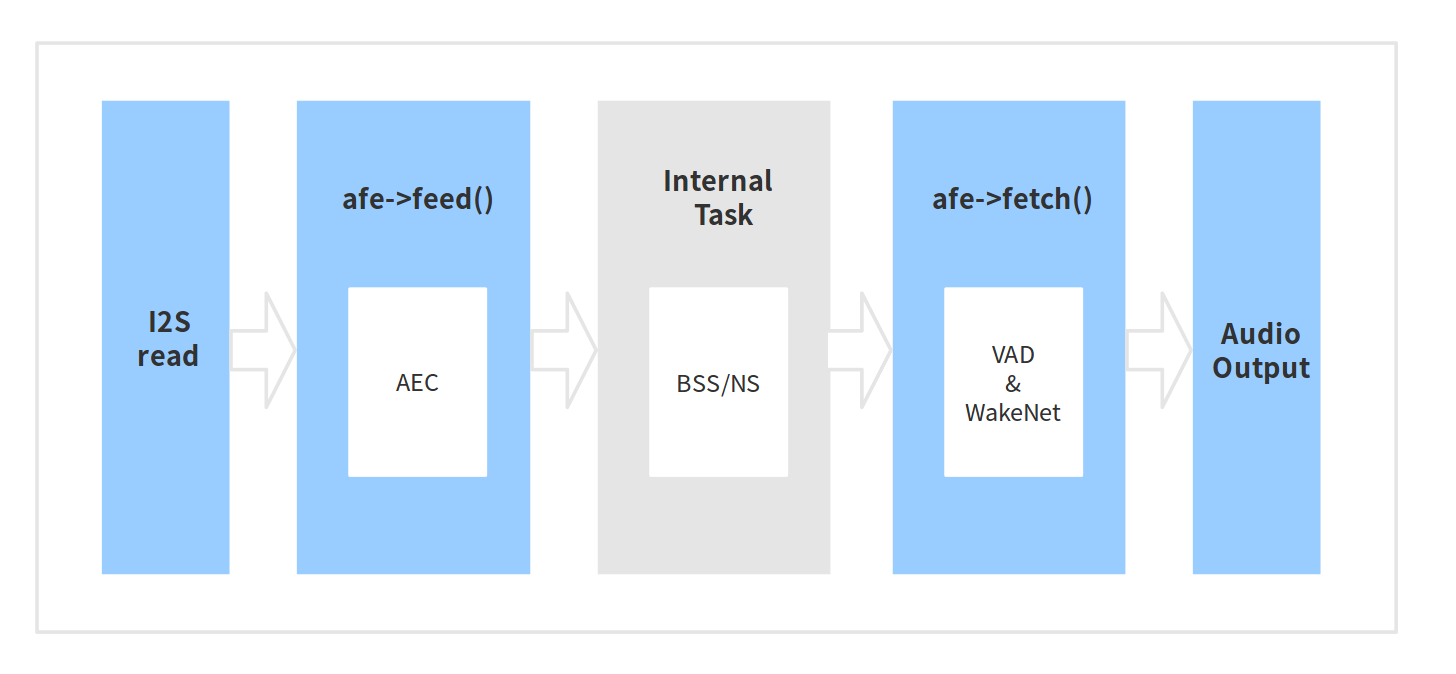
乐鑫 AFE 工作流程可以分为 4 块:
- AFE 的创建和初始化
- AFE feed,输入音频数据,feed 内部会先进行 AEC 算法处理
- 内部:AFE BSS/NS 算法处理
- AFE fetch,返回处理过的音频数据和返回值, fetch 内部会进行 VAD 处理,如果用户设置 WakeNet 为 enable 状态,也会进行唤醒词的检测
其中 `afe->feed()` 和 `afe->fetch()` 对用户可见,`Internal BSS/NS Task` 对用户不可见。
> AEC 在 afe->feed() 函数中运行;
> BSS/NS 为 AFE 内部独立 Task 进行处理;
> VAD 和 WakeNet 的结果通过 afe->fetch() 函数中获取。
### 选择 AFE handle
目前 AFE 支持单麦和双麦两种应用场景,单麦场景内部 Task 为 NS 处理,双麦场景内部 Task 为 BSS 处理。
- 单麦
esp_afe_sr_iface_t *afe_handle = &esp_afe_sr_1mic;
- 双麦
esp_afe_sr_iface_t *afe_handle = &esp_afe_sr_2mic;
### 输入音频
- AFE 单麦场景
- 输入音频格式为 16KHz, 16bit, 双通道(1个通道为 mic 数据,另一个通道为参考回路)
- 数据帧长为 32ms, 用户可以使用 `afe->get_feed_chunksize` 来获取需要的采样点数目(采样点数据类型为 int16)
数据排布如下:
 - AFE 双麦场景
- 输入音频格式为 16KHz, 16bit, 三通道
- 数据帧长为 32ms, 用户可以使用 `afe->get_feed_chunksize` 来获取需要填充的数据量
数据排布如下:
- AFE 双麦场景
- 输入音频格式为 16KHz, 16bit, 三通道
- 数据帧长为 32ms, 用户可以使用 `afe->get_feed_chunksize` 来获取需要填充的数据量
数据排布如下:
 注意:换算成数据量大小为:`afe->get_feed_chunksize * 通道数 * sizeof(short)`
### AEC 简介
AEC (Acoustic Echo Cancellation) 算法最多支持双麦处理,能够有效的去除 mic 输入信号中的自身播放声音。从而可以在自身播放音乐的情况下进行很好的语音识别等应用。
### NS 简介
NS (Noise Suppression) 算法支持单通道处理,能够对单通道音频中的非人声噪声进行抑制,尤其针对稳态噪声,具有很好的抑制效果。
### BSS 简介
BSS (Blind Source Separation) 算法支持双通道处理,能够很好的将目标声源和其余干扰音进行盲源分离,从而提取出有用音频信号,保证了后级语音的质量。
### VAD 简介
VAD (Voice Activity Detection) 算法支持实时输出当前帧的语音活动状态。
### WakeNet or Bypass 简介
用户可以选择是否在 AFE 中进行唤醒词的识别。当用户调用 `afe->disable_wakenet(afe_data)` 后,则进入 Bypass 模式,AFE 模块不会进行唤醒词的识别。
### 输出音频
AFE 的输出音频为单通道数据,在 WakeNet 开启的情况下,AFE 会输出有目标人声的单通道数据。
---
## 快速开始
### 1. 定义 afe_handle
`afe_handle` 是用户后续调用 afe 接口的函数句柄。用户需要根据单麦和双麦场景选择对应的 `afe_handle`。
单麦场景:
esp_afe_sr_iface_t *afe_handle = &esp_afe_sr_1mic;
双麦场景:
esp_afe_sr_iface_t *afe_handle = &esp_afe_sr_2mic;
### 2. 配置 afe
获取 afe 的配置:
afe_config_t afe_config = AFE_CONFIG_DEFAULT();
可在宏`AFE_CONFIG_DEFAULT()`中调整各算法模块的使能及其相应参数:
```
#define AFE_CONFIG_DEFAULT() { \
.aec_init = true, \
.se_init = true, \
.vad_init = true, \
.wakenet_init = true, \
.vad_mode = 3, \
.wakenet_model = &WAKENET_MODEL, \
.wakenet_coeff = &WAKENET_COEFF, \
.wakenet_mode = DET_MODE_2CH_90, \
.afe_mode = SR_MODE_HIGH_PERF, \
.afe_perferred_core = 0, \
.afe_perferred_priority = 5, \
.afe_ringbuf_size = 50, \
.alloc_from_psram = 1, \
.agc_mode = 2, \
}
```
- aec_init: AEC 算法是否使能。
- se_init: BSS/NS 算法是否使能。
- vad_init: VAD 是否使能。
- wakenet_init: 唤醒是否使能。
- vad_mode: VAD 检测的操作模式,越大越激进。
- wakenet_model/wakenet_coeff/wakenet_mode: 使用 `make menuconfig` 来选择相应的唤醒模型,详见:[WakeNet](https://github.com/espressif/esp-sr/tree/b9504e35485b60524977a8df9ff448ca89cd9d62/wake_word_engine)
- afe_mode: 乐鑫 AFE 目前支持 2 种工作模式,分别为:SR_MODE_LOW_COST, SR_MODE_HIGH_PERF。详细可见 afe_sr_mode_t 枚举。
- SR_MODE_LOW_COST: 量化版本,占用资源较少。
- SR_MODE_HIGH_PERF: 非量化版本,占用资源较多。
**ESP32 芯片,只支持模式 SR_MODE_HIGH_PERF;
ESP32S3 芯片,两种模式均支持 **
- afe_perferred_core: AFE 内部 BSS/NS 算法,运行在哪个 CPU 核。
- afe_ringbuf_size: 内部 ringbuf 大小的配置。
- alloc_from_psram: 是否优先从外部 psram 分配内存。可配置三个值:
- 0: 从内部ram分配。
- 1: 部分从外部psram分配。
- 2: 绝大部分从外部psram分配
- agc_mode: 将音频线性放大的 level 配置([0,3]),0 表示无放大
### 3. 创建 afe_data
用户使用 `afe_handle->create_from_config(&afe_config)` 函数来获得数据句柄,这将会在afe内部使用,传入的参数即为上面第2步中获得的配置。
```
/**
* @brief Function to initialze a AFE_SR instance
*
* @param afe_config The config of AFE_SR
* @returns Handle to the AFE_SR data
*/
typedef esp_afe_sr_data_t* (*esp_afe_sr_iface_op_create_from_config_t)(afe_config_t *afe_config);
```
### 4. feed 音频数据
在初始化 AFE 和 WakeNet 完成后,用户需要将音频数据使用 `afe_handle->feed()` 函数输入到 AFE 中进行处理。
输入的音频大小和排布格式可以参考 **输入音频** 这一步骤。
```
/**
* @brief Feed samples of an audio stream to the AFE_SR
*
*
* @param afe The AFE_SR data handle
*
* @param in The input microphone signal, only support signed 16-bit @ 16 KHZ. The frame size can be queried by the
* `get_samp_chunksize`. The channel number can be queried `get_channel_num`.
* @return The size of input
*/
typedef int (*esp_afe_sr_iface_op_feed_t)(esp_afe_sr_data_t *afe, const int16_t* in);
```
获取音频通道数:
使用 `afe_handle->get_channel_num()` 函数可以获取需要传入 `afe_handle->feed()` 函数的 mic 数据通道数。(不含参考回路通道)
```
/**
* @brief Get the channel number of samples that need to be passed to the fetch function
*
* @param afe The AFE_SR object to query
* @return The amount of channel number
*/
typedef int (*esp_afe_sr_iface_op_get_channel_num_t)(esp_afe_sr_data_t *afe);
```
### 5. fetch 音频数据
用户调用 `afe_handle->fetch()` 函数可以获取处理完成的单通道音频。
fetch 的数据采样点数目(采样点数据类型为 int16)可以通过 `afe_handle->get_fetch_chunksize` 获取。
```
/**
* @brief Get the amount of each channel samples per frame that need to be passed to the function
*
* Every speech enhancement AFE_SR processes a certain number of samples at the same time. This function
* can be used to query that amount. Note that the returned amount is in 16-bit samples, not in bytes.
*
* @param afe The AFE_SR object to query
* @return The amount of samples to feed the fetch function
*/
typedef int (*esp_afe_sr_iface_op_get_samp_chunksize_t)(esp_afe_sr_data_t *afe);
```
用户需要注意 `afe_handle->fetch()` 的返回值:
- AFE_FETCH_CHANNEL_VERIFIED: 音频通道确认 (单麦唤醒,不返回该值)
- AFE_FETCH_NOISE: 侦测到噪声
- AFE_FETCH_SPEECH: 侦测到语音
- AFE_FETCH_WWE_DETECTED: 侦测到唤醒词
- ...
```
/**
* @brief fetch enhanced samples of an audio stream from the AFE_SR
*
* @Warning The output is single channel data, no matter how many channels the input is.
*
* @param afe The AFE_SR object to query
* @param out The output enhanced signal. The frame size can be queried by the `get_samp_chunksize`.
* @return The state of output, please refer to the definition of `afe_fetch_mode_t`
*/
typedef afe_fetch_mode_t (*esp_afe_sr_iface_op_fetch_t)(esp_afe_sr_data_t *afe, int16_t* out);
```
### 6. WakeNet 使用
当用户在唤醒后需要进行其他操作,比如离线或在线语音识别,这时候可以暂停 WakeNet 的运行,从而减轻 CPU 的资源消耗。
用户可以调用 `afe_handle->disable_wakenet(afe_data)` 来停止 WakeNet。 当后续应用结束后又可以调用 `afe_handle->enable_wakenet(afe_data)` 来开启 WakeNet。
### 7. AEC 使用
AEC 的使用和 WakeNet 相似,用户可以根据自己的需求来停止或开启 AEC。
- 停止 AEC
afe->disable_aec(afe_data);
- 开启 AEC
afe->enable_aec(afe_data);
注意:换算成数据量大小为:`afe->get_feed_chunksize * 通道数 * sizeof(short)`
### AEC 简介
AEC (Acoustic Echo Cancellation) 算法最多支持双麦处理,能够有效的去除 mic 输入信号中的自身播放声音。从而可以在自身播放音乐的情况下进行很好的语音识别等应用。
### NS 简介
NS (Noise Suppression) 算法支持单通道处理,能够对单通道音频中的非人声噪声进行抑制,尤其针对稳态噪声,具有很好的抑制效果。
### BSS 简介
BSS (Blind Source Separation) 算法支持双通道处理,能够很好的将目标声源和其余干扰音进行盲源分离,从而提取出有用音频信号,保证了后级语音的质量。
### VAD 简介
VAD (Voice Activity Detection) 算法支持实时输出当前帧的语音活动状态。
### WakeNet or Bypass 简介
用户可以选择是否在 AFE 中进行唤醒词的识别。当用户调用 `afe->disable_wakenet(afe_data)` 后,则进入 Bypass 模式,AFE 模块不会进行唤醒词的识别。
### 输出音频
AFE 的输出音频为单通道数据,在 WakeNet 开启的情况下,AFE 会输出有目标人声的单通道数据。
---
## 快速开始
### 1. 定义 afe_handle
`afe_handle` 是用户后续调用 afe 接口的函数句柄。用户需要根据单麦和双麦场景选择对应的 `afe_handle`。
单麦场景:
esp_afe_sr_iface_t *afe_handle = &esp_afe_sr_1mic;
双麦场景:
esp_afe_sr_iface_t *afe_handle = &esp_afe_sr_2mic;
### 2. 配置 afe
获取 afe 的配置:
afe_config_t afe_config = AFE_CONFIG_DEFAULT();
可在宏`AFE_CONFIG_DEFAULT()`中调整各算法模块的使能及其相应参数:
```
#define AFE_CONFIG_DEFAULT() { \
.aec_init = true, \
.se_init = true, \
.vad_init = true, \
.wakenet_init = true, \
.vad_mode = 3, \
.wakenet_model = &WAKENET_MODEL, \
.wakenet_coeff = &WAKENET_COEFF, \
.wakenet_mode = DET_MODE_2CH_90, \
.afe_mode = SR_MODE_HIGH_PERF, \
.afe_perferred_core = 0, \
.afe_perferred_priority = 5, \
.afe_ringbuf_size = 50, \
.alloc_from_psram = 1, \
.agc_mode = 2, \
}
```
- aec_init: AEC 算法是否使能。
- se_init: BSS/NS 算法是否使能。
- vad_init: VAD 是否使能。
- wakenet_init: 唤醒是否使能。
- vad_mode: VAD 检测的操作模式,越大越激进。
- wakenet_model/wakenet_coeff/wakenet_mode: 使用 `make menuconfig` 来选择相应的唤醒模型,详见:[WakeNet](https://github.com/espressif/esp-sr/tree/b9504e35485b60524977a8df9ff448ca89cd9d62/wake_word_engine)
- afe_mode: 乐鑫 AFE 目前支持 2 种工作模式,分别为:SR_MODE_LOW_COST, SR_MODE_HIGH_PERF。详细可见 afe_sr_mode_t 枚举。
- SR_MODE_LOW_COST: 量化版本,占用资源较少。
- SR_MODE_HIGH_PERF: 非量化版本,占用资源较多。
**ESP32 芯片,只支持模式 SR_MODE_HIGH_PERF;
ESP32S3 芯片,两种模式均支持 **
- afe_perferred_core: AFE 内部 BSS/NS 算法,运行在哪个 CPU 核。
- afe_ringbuf_size: 内部 ringbuf 大小的配置。
- alloc_from_psram: 是否优先从外部 psram 分配内存。可配置三个值:
- 0: 从内部ram分配。
- 1: 部分从外部psram分配。
- 2: 绝大部分从外部psram分配
- agc_mode: 将音频线性放大的 level 配置([0,3]),0 表示无放大
### 3. 创建 afe_data
用户使用 `afe_handle->create_from_config(&afe_config)` 函数来获得数据句柄,这将会在afe内部使用,传入的参数即为上面第2步中获得的配置。
```
/**
* @brief Function to initialze a AFE_SR instance
*
* @param afe_config The config of AFE_SR
* @returns Handle to the AFE_SR data
*/
typedef esp_afe_sr_data_t* (*esp_afe_sr_iface_op_create_from_config_t)(afe_config_t *afe_config);
```
### 4. feed 音频数据
在初始化 AFE 和 WakeNet 完成后,用户需要将音频数据使用 `afe_handle->feed()` 函数输入到 AFE 中进行处理。
输入的音频大小和排布格式可以参考 **输入音频** 这一步骤。
```
/**
* @brief Feed samples of an audio stream to the AFE_SR
*
*
* @param afe The AFE_SR data handle
*
* @param in The input microphone signal, only support signed 16-bit @ 16 KHZ. The frame size can be queried by the
* `get_samp_chunksize`. The channel number can be queried `get_channel_num`.
* @return The size of input
*/
typedef int (*esp_afe_sr_iface_op_feed_t)(esp_afe_sr_data_t *afe, const int16_t* in);
```
获取音频通道数:
使用 `afe_handle->get_channel_num()` 函数可以获取需要传入 `afe_handle->feed()` 函数的 mic 数据通道数。(不含参考回路通道)
```
/**
* @brief Get the channel number of samples that need to be passed to the fetch function
*
* @param afe The AFE_SR object to query
* @return The amount of channel number
*/
typedef int (*esp_afe_sr_iface_op_get_channel_num_t)(esp_afe_sr_data_t *afe);
```
### 5. fetch 音频数据
用户调用 `afe_handle->fetch()` 函数可以获取处理完成的单通道音频。
fetch 的数据采样点数目(采样点数据类型为 int16)可以通过 `afe_handle->get_fetch_chunksize` 获取。
```
/**
* @brief Get the amount of each channel samples per frame that need to be passed to the function
*
* Every speech enhancement AFE_SR processes a certain number of samples at the same time. This function
* can be used to query that amount. Note that the returned amount is in 16-bit samples, not in bytes.
*
* @param afe The AFE_SR object to query
* @return The amount of samples to feed the fetch function
*/
typedef int (*esp_afe_sr_iface_op_get_samp_chunksize_t)(esp_afe_sr_data_t *afe);
```
用户需要注意 `afe_handle->fetch()` 的返回值:
- AFE_FETCH_CHANNEL_VERIFIED: 音频通道确认 (单麦唤醒,不返回该值)
- AFE_FETCH_NOISE: 侦测到噪声
- AFE_FETCH_SPEECH: 侦测到语音
- AFE_FETCH_WWE_DETECTED: 侦测到唤醒词
- ...
```
/**
* @brief fetch enhanced samples of an audio stream from the AFE_SR
*
* @Warning The output is single channel data, no matter how many channels the input is.
*
* @param afe The AFE_SR object to query
* @param out The output enhanced signal. The frame size can be queried by the `get_samp_chunksize`.
* @return The state of output, please refer to the definition of `afe_fetch_mode_t`
*/
typedef afe_fetch_mode_t (*esp_afe_sr_iface_op_fetch_t)(esp_afe_sr_data_t *afe, int16_t* out);
```
### 6. WakeNet 使用
当用户在唤醒后需要进行其他操作,比如离线或在线语音识别,这时候可以暂停 WakeNet 的运行,从而减轻 CPU 的资源消耗。
用户可以调用 `afe_handle->disable_wakenet(afe_data)` 来停止 WakeNet。 当后续应用结束后又可以调用 `afe_handle->enable_wakenet(afe_data)` 来开启 WakeNet。
### 7. AEC 使用
AEC 的使用和 WakeNet 相似,用户可以根据自己的需求来停止或开启 AEC。
- 停止 AEC
afe->disable_aec(afe_data);
- 开启 AEC
afe->enable_aec(afe_data);